Back to all articles Dr Wayengera (CDF1545) meets His Excellency President Museveni, President of Uganda
Thu, Nov 7, 2019

Dr Wayengera (CDF1545) meets His Excellency President Museveni, President of Uganda


President Museveni has congratulated Dr. Misaki Wayengera, a Researcher at Makerere University College of Health Sciences, for his efforts in developing a rapid test kit to diagnose the deadly Ebola and Marburg viruses. Dr Wayengera is an EDCTP Career Development Fellow (TMA2016CDF1545).

“I want to congratulate our scientists because they are really waking up and producing a lot of products. The Government will fund you. It is the issue of prioritization and putting the money in the right place,” he said. The President was on Tuesday speaking during a meeting at State House, Entebbe to recognize Dr. Misaki Wayengera who recently won the World Health Organization (WHO) high innovation challenge in Product Development Category that took place at the WHO Africa Regional Headquarters in Congo (Brazzaville).

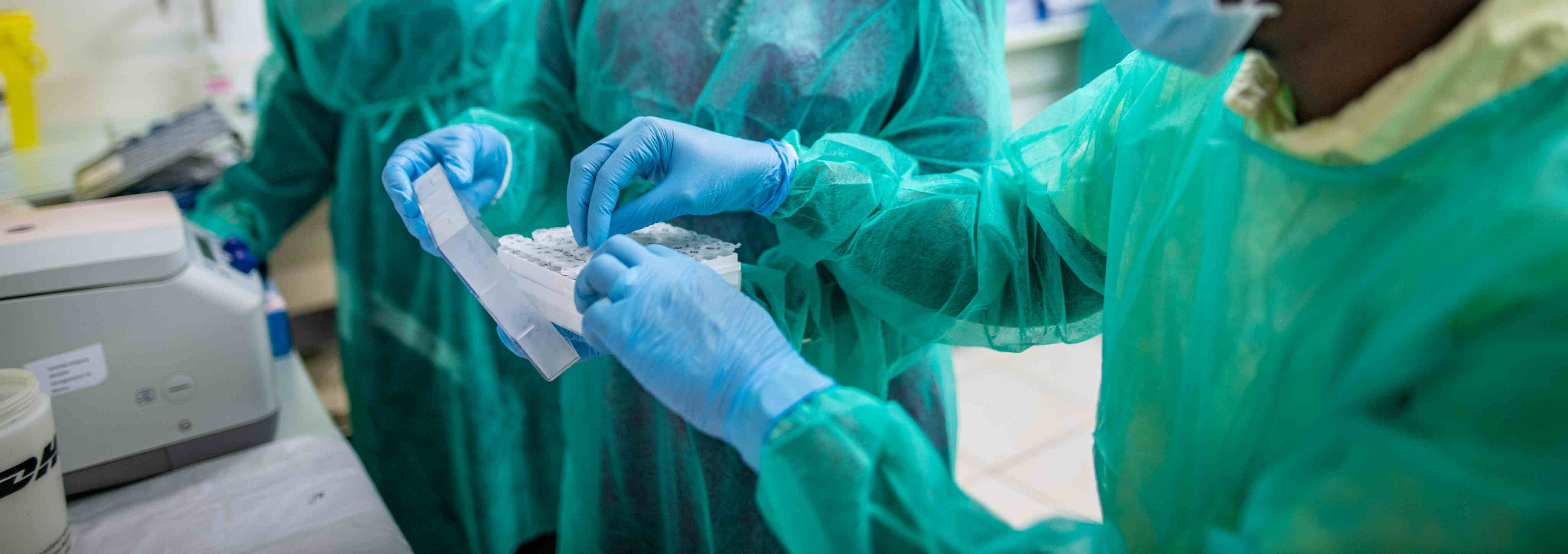
Dr Wayengera’s invention also known as Pan-Filovirus Rapid Diagnostic Test, uses a paper-strip test, like the one used in testing for pregnancy. This, however, will be used in detecting Ebola, Marburg and other hemorrhagic fevers. Africa has had several hemorrhagic fever outbreaks especially Ebola Virus Disease (EVD) with the latest and ongoing outbreak currently in the Democratic Republic of Congo that borders Uganda to the West. Rapid diagnosis is important in informing key decisions especially interventions and measures to take in the event of a disease outbreak. If approved by health authorities including the World Health Organization (WHO) and partners, Dr Wayengera’s Pan-Filovirus Rapid Diagnostic Test will go a long way in improving rapid tests and turnaround time for results during disease outbreaks. President Museveni said that the Government of Uganda will support the efforts of the researchers by establishing a manufacturing facility that will enable them to put all the products together. He commended Dr. Wayengera and his team on the achievements realized adding that the research can bring in a host of benefits to society because the products form the core that addresses many human challenges such as hemorrhage fevers and HIV afflictions that immensely affect the world. The President observed that Uganda has, on several occasions, been attacked by epidemics, including Ebola and Marburg, resulting in the deaths of trained preventive workers and wananchi. State Minister for Health, Hon. Sarah Ochieng Opendi, saluted Dr. Wayengera and his team for the innovation saying their efforts will go a long way in easing the diagnosis of viral hemorrhage fevers such as Ebola and Marburg. Dr. Wayengera, on his part, thanked President Museveni for recognizing their efforts and his support.

Articles

Fri, Nov 21, 2025

Free Access To The Spirit Electronic Protocol Tool And Resource (Septre) Platform

The Global Health Network, EDCTP, and Women’s College Hospital at the University of Toronto have extended their partnership to provide continued access to the SPIRIT Electronic Protocol Tool and Resource (SEPTRE) platform. Through this collaboration, a limited number of free three-year licenses remain available for researchers in low- and middle-income countries (LMICs) who may not otherwise afford access.


SEPTRE is an online tool that helps researchers design, manage, and register high-quality clinical trial protocols in line with the SPIRIT (Standard Protocol Items: Recommendations for Interventional Trials) guidelines, which were updated in 2025. The update introduced new sections on open science, harms assessment, intervention descriptions, and patient and public involvement.


Applications can be submitted through the EDCTP Knowledge Hub SEPTRE enquiry form. Applicants should be located in a low- or middle-income country (preference is given to researchers based in Africa and who are members of the EDCTP Knowledge Hub). We encourage applicants via the form to state their goals and objectives to apply for a SEPTRE license and the research they want to undertake. Successful applicants agree that they will submit a yearly report on how they have made use of the license.


Learn more about the EDCTP Knowledge Hub.

Read more
Thu, Oct 30, 2025

Edctp Association Mourns The Passing Of Professor Jean Louis Abdourahim Ndiaye

The EDCTP Association deeply mourns the loss of Professor Jean Louis Abdourahim Ndiaye, joining the global health community in honouring an outstanding researcher whose impact will continue to be felt across the global health research field.


Professor Ndiaye was awarded a Senior Fellowship in 2011 under the EDCTP1 programme to conduct research on seasonal malaria chemoprophylaxis (SMC). He led transformative malaria prevention research, including innovative seasonal intermittent preventive treatment in children (IPTc), and continued to develop his research on preventing and protecting children from malaria. At the University of Thiès, Senegal, he built a research team and went on to head the OPT-SMC project, funded under the EDCTP2 programme, which focused on strengthening the capacity of national malaria control programmes in conducting implementation research to improve SMC delivery and impact. This project supported 13 countries across West and Central Africa (Benin, Burkina Faso, Cameroon, Chad, The Gambia, Ghana, Guinea, Guinea-Bissau, Mali, Mauritania, Niger, Nigeria, Senegal, and Togo), bringing together national malaria programme representatives to share expertise and tailor interventions to local contexts.


Professor Ndiaye was not only a leading scientist but also a kind and humble man, deeply committed to reducing the burden of malaria in Africa and developing the next generation of African researchers. His contributions have made a significant impact on malaria control and implementation research. His passing is a considerable loss to the global scientific community, particularly in Africa. He will be deeply missed. We extend our condolences to his family, friends, and colleagues.

Read more
Featured Thu, Jul 3, 2025

Prof. George Boateng Kyei: Advancing Hiv Research In Africa

In his EDCTP-GSK Senior Fellowship, Professor George Boateng Kyei of the Noguchi Memorial Institute for Medical Research, University of Ghana, has not only advanced the search for an HIV cure but also strengthened research capacity across Ghana and the broader African region.


Addressing HIV persistence

HIV remains a pressing public health issue in Africa, with persistent challenges hindering the quest for a cure. This fellowship project focused on one such challenge: the virus’s ability to remain dormant within resting CD4+ T cells, even among individuals receiving antiretroviral therapy (ART). By exploring the innovative “shock and kill” approach, the research aimed to reactivate latent HIV and target infected cells for destruction. A notable scientific achievement was the identification and confirmation of three novel epigenetic compounds capable of reactivating latent HIV from virologically suppressed individuals. These findings pave the way for future studies in animal models, with the potential to transition into clinical trials aiming at finding a cure for HIV.


Strengthening research infrastructure

The establishment of a drug screening platform at the University of Ghana stands out as a long-term asset for HIV drug discovery and cure research. Additionally, the project introduced regular viral load monitoring for a substantial cohort of patients—an essential practice previously not standard in Ghana. The data generated from this monitoring has been instrumental in shaping national HIV treatment policies and improving patient care.


Furthermore, the project developed a biobank and a well-characterised cohort of HIV-infected adults, providing invaluable resources for ongoing and future HIV cure research. Insights gathered from patients regarding their perceptions of HIV cure research will inform the design and conduct of subsequent studies in Ghana and across Africa.


Training the next generation of researchers

The impact of the fellowship extends beyond laboratory accomplishments; it has significantly influenced research training and career development. The fellowship helped nurture the growth of junior scientists, many of whom have evolved into independent research leaders, securing competitive grants and fellowships, such as the IAS Research-for-Cure Academy and NIH R21. They have presented their findings at prestigious international conferences, including the African Virology Congress and the American Society of Tropical Medicine and Hygiene (ASTMH).


Post-doctoral fellows have notably received fellowships from esteemed international programmes, such as the Science by Women Fellowship and the NIH CFAR Africure award, showcasing their growing prominence in the research community.


Recognition and awards

Professor Kyei’s mentorship has not gone unnoticed; in April 2024, he received special recognition from the University of Ghana’s Centre for Gender Studies and Advocacy (CEGENSA) for his outstanding mentorship of female academics—an honour highlighted by nominations from his own mentees. The project also celebrated the achievements of its team members, with one post-doc winning Best Senior Research Fellow at the 2024 NMIMR Awards and research assistants earning accolades at the 2024 African Virologist Conference.


Professor Kyei’s research has led to significant international visibility, with his team members winning travel awards to attend prestigious conferences, including the Keystone Symposium and the African Virology Congress. These opportunities have allowed them to present their findings and collaborate with global experts in the field.


Expanding horizons

The EDCTP-GSK Senior Fellowship grant has facilitated the groundwork for additional projects, including a newly awarded Fogarty grant aimed at enhancing HIV basic science and cure research training at the University of Ghana. This grant will train 17 researchers over the next 5 years, further strengthening the research landscape in Ghana.


As the team looks to the future, plans are in place to expand research into HIV reservoir characteristics among virologically suppressed patients across Ghana. This extension not only continues the momentum generated by the EDCTP grant, but also reinforces Ghana’s position as a leader in HIV cure research in Africa and contributes to the global effort to eradicate HIV.

Read more